
Water purification technology
Until recently, the main method of ultrapure water generation was distillation. The method has been useful, especially for generation of water for injection, but it has a number of limits. Firstly, the product water has a very high cost, due to the consumption of electricity for evaporation and cooling water for subsequent condensation.
Secondly, it is impossible to generate ultrapure water by distillation, even using multiple. The reached limit is theso-called "Kohlrausch water", generated by 42 successive distillations and having a resistivity of 16.4 MΩ * cm at 25 ° C.
The modern approach to the production of high purified water is based on a combination of several physical and chemical processes. They remove step-by-step impurities with various phase-dispersed states from water without changing their phase state. As a result, the cost price is sharply reduced compared to distillation, and the degree of purification becomes order of magnitude greater and almost approaches the theoretical limit.
Mechanical purification or filtration
Mechanical filtration can be used at different stages of water purification depending on the application task. The principle of mechanical filtration is simple: particles larger than the size of the filter pores are trapped on the surface or in the layer of the filter material. This method means to remove insoluble substances in the initial stages of purification and microorganisms in the final stages.
The simplest example of a mechanical filtration device is a granular-bed filter. The granules of the filter media create a porous layer. When water passes through the bed, particles are trapped on the granule surface an adhere to the already trapped particles. This type of mechanical filtration is used in the CFC granular-bed filter cartridges.
Microfiltration is a membrane separation process perform by filtering liquid through a porous membrane of polymer material. This method can also be referred as "mechanical filtration".
In order to increase the capacity of filters, as well as their throughput capacity, the filter surface should be increased. Pleated filters, where the filtering sheet has "concertino" configuration, allow to increase significantly the filtration surface with the current compactness of the filter element.
Filters operating on the principle of depth filtration can also be used. As the water passes through the filter, the pore size gradually decreases. It allows larger the particles to be trapped closer to the surface, while the smaller particles are trapped in the filter layer. This technology is used in the MFC microfiltration cartridges.
Sorption helps to remove organic matter and active chlorine from water. The most frequently used sorbents are activated carbons.
Activated carbon is a porous material with wide range of pore geometry and size. Organic matter and some gases are adsorbed inside the branched pores and retained there by intermolecular interaction. Also, chemical reactions (chemisorption) can take place on the sorbent surface. In particular, the removal of active chlorine by activated carbon is based on chemisorption mechanism. Activated carbon sorption is used in the ACC activated carbon sorption cartridges.
The filter has a certain sorption capacity. When saturation is achieved, there may be an increase in the pollutant concentration in the water downstream the filter due to the desorption process.
It is worth noting that activated carbon is a favorable environment for the growth of microorganisms due to the high porosity and the presence of absorbed organics in the pores. Timely replacement of the filter is extremely important, because otherwise it can become a source of secondary microbiological contamination.
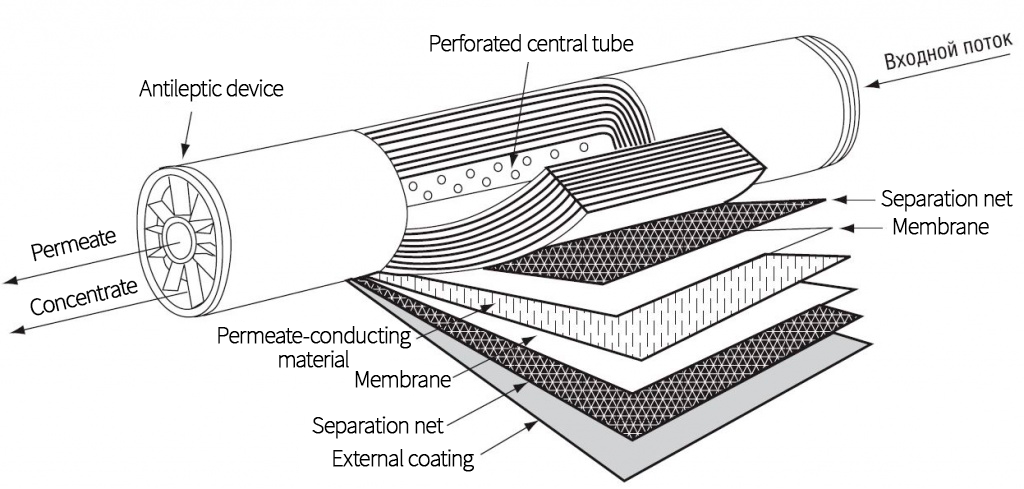
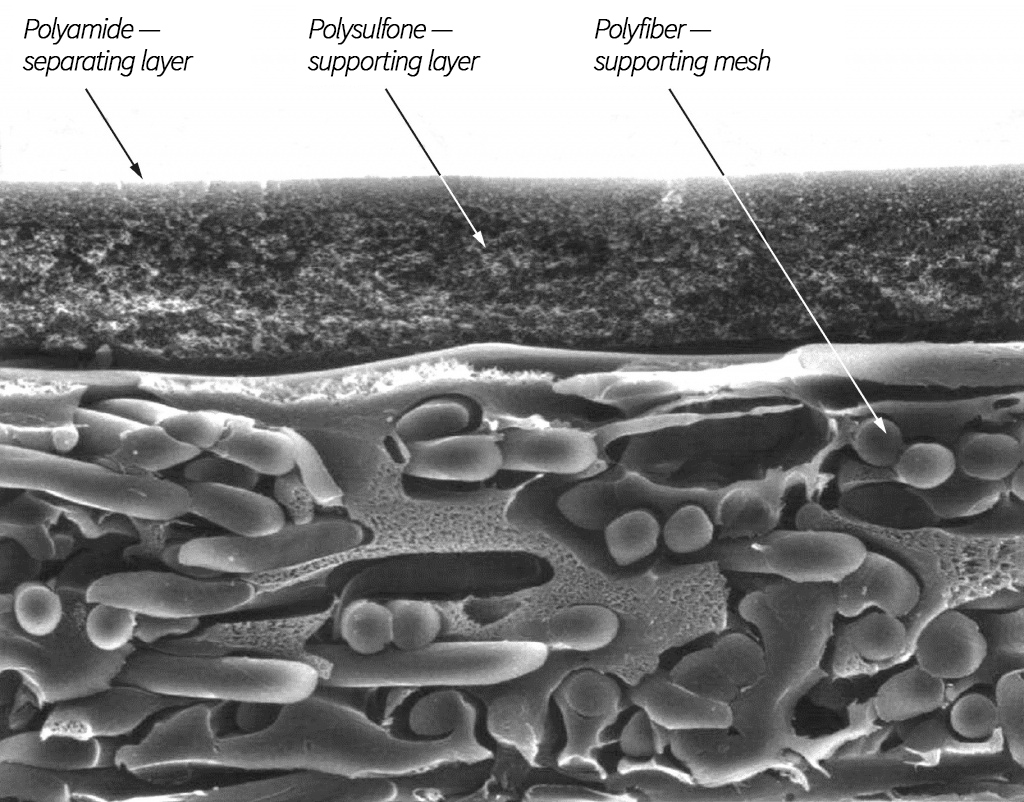
Reverse osmosis membrane filtration is currently the most modern and cost-effective method of desalination that allows up to 99% of dissolved salts to be removed from water.
The effect of direct osmosis is water molecules pass through a membrane (permeable to water) from a less concentrated solution to a more concentrated one until the concentration of solutions on both sides of the membrane are equalized. The reverse osmosis principle is opposite of direct osmosis: excess pressure is created on the concentrated side and pure water passes through the membrane into the less concentrated solution.
Special devices are utilized in the modern realization of the reverse osmosis technology in desalination water systems. These devices are called membrane elements. The most common are spiral-wound membrane elements where membrane sheets are rolled around a filtrate removal tube. Membrane elements of this design are used in the ROC membrane cartridges.
To ensure efficient desalination, concentrated solution (concentrate) is continuously rejected from the membrane surface and replaced with feed water. Pure water (permeate) is taken off through a central tube and, if necessary, forwarded to final purification.
Ion exchange is the process of replacing ions of dissolved substances from solution with ions from a special matrix (resin). Ion exchange resins can exchange cations or anions. Ion exchange as a purification method is used both in the early stages of water treatment and for final demineralization. Resins of different classes and degrees of purity are utilized for this purpose.
Cation exchange filters are used in the pretreatment systems to remove hardness (softening process). Softening filters use resins enriched with sodium ions. When water is passed through the filters, calcium and magnesium ions from the solution bind with the resin and replace the sodium ions. As all sodium ions on the resin are replaced, the filter's resource is exhausted, and it can no longer perform the softening. The filters can be regenerated by concentrated solution of sodium salt passing through the filter.
The regeneration process is the opposite of what is described above. This technology is utilized in water softening units.
In the later stages of treatment, mixtures of special cation-exchange and anion-exchange resins with H+ and OH- ions in them are used.
When the solution passes through such filter, the cations and anions of salts bind with the resin, releasing the H+ and OH- ions, which are neutralized and generate water. Mixed ion exchange resins can be used to obtain deeply desalinated water with a specific resistance of 18.2 MΩ (at 25°C). This technology is used in the MBC, MBC-MR, and MBC-UPW cartridges.
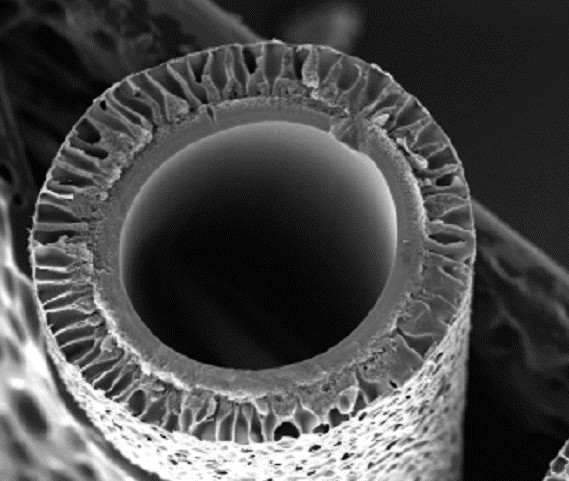
Ultrafiltration is the most effective method to remove from water mechanical particles of 0.01- 0.1-micron size, colloids, microbes, viruses, and large organic molecules. Ultrafiltration as well as microfiltration is a membrane separation process what means filtration of liquid through a porous hydrophilic membrane of polymeric origin.
Typical ultrafiltration elements are constructed from many single-channel or multi-channel hollow fibers. Each fiber has a cylindrical shape and has a supporting layer and a selective filtering layer.
Ultrafiltration membrane elements are used in medicine and pharma because of their ability to retain pyrogens, which are usually particles of microorganism cell walls. The Aqualab AL UF units use ultrafiltration technology for this purpose.
UV treatment is a method of preventing microbiological contamination. The water stream passes along special UV lamps with peak radiation intensity at wavelength range of 250-260 nm. UV exposure with the specified wavelength on the strand of the microorganism DNA (or RNA) causes mutation of thymine bases, that makes production and synthesis of vital proteins impossible. Increased doses (intensities) of irradiation can also cause destruction of the cell wall. In both cases the microorganism dies, but cell wall residuals, proteins and pyrogens release into the solution.
Hi-energy UV radiation with wavelength of 180- 190 nm can be used to destroy organic molecules and microorganisms. The underlying mechanism is generation of free radicals that can oxidize any organic compound.
UV modules are used in the Aqualab AL Plus and Aqualab S18 (Supreme).
Degasification is a process of removing dissolved gases from water. The simplest method of degassing is heating. As the temperature increases, the solubility of gases in water decreases, but during cooling, if the partial pressures have not changed, gases dissolve back.
Modern degasification methods use hydrophobic hollow fiber membranes and vacuum pumps or carrier-gases (gas stripping method). Vacuum pumps create vacuum on the outer side of the hollow fiber and, according to Henry's law of partial pressures, the dissolved gases are removed from the water. Hydrophobic nature of the special membrane material prevents water from being sucked together with gases due to capillary forces. Carrier-gas method has a similar principle: dissolved gases are removed from the solution being replaced by the carrier-gas. Choice of the method depends on the task. For example, for full degasification vacuum pumps are required, while gas stripping method can be utilized for selective degasification, etc.